Rooftop Tent vs. Campervan Rental – A Comparison of Two Travel Styles
Travel today is no longer just about the destination, but also about how we get there. For those seeking close‑to‑nature experiences, rooftop tents are becoming increasingly popular, while campervans and motorhomes remain synonymous with comfort and all‑inclusive convenience. Opinions, however, are often divided—especially when it comes to choosing the right type of accommodation.
In this article, we compare the advantages and disadvantages of traveling with a rooftop tent versus a campervan in terms of comfort, experience, flexibility, and costs, helping you decide which travel style best suits your needs.
Freedom on Four Wheels – But Which Ones?
Traveling with a rooftop tent is much closer to the classic camping experience. During the day, your car functions just like any other vehicle, while in the evening the rooftop tent can be transformed into a sleeping space in just a few simple steps. This kind of simplicity naturally brings spontaneity with it: it’s easier to leave the paved road, stop at a forest clearing or on a mountaintop, and spend the night wherever it feels right. In moments like these, nature is no longer just a backdrop, but an active participant in the journey.

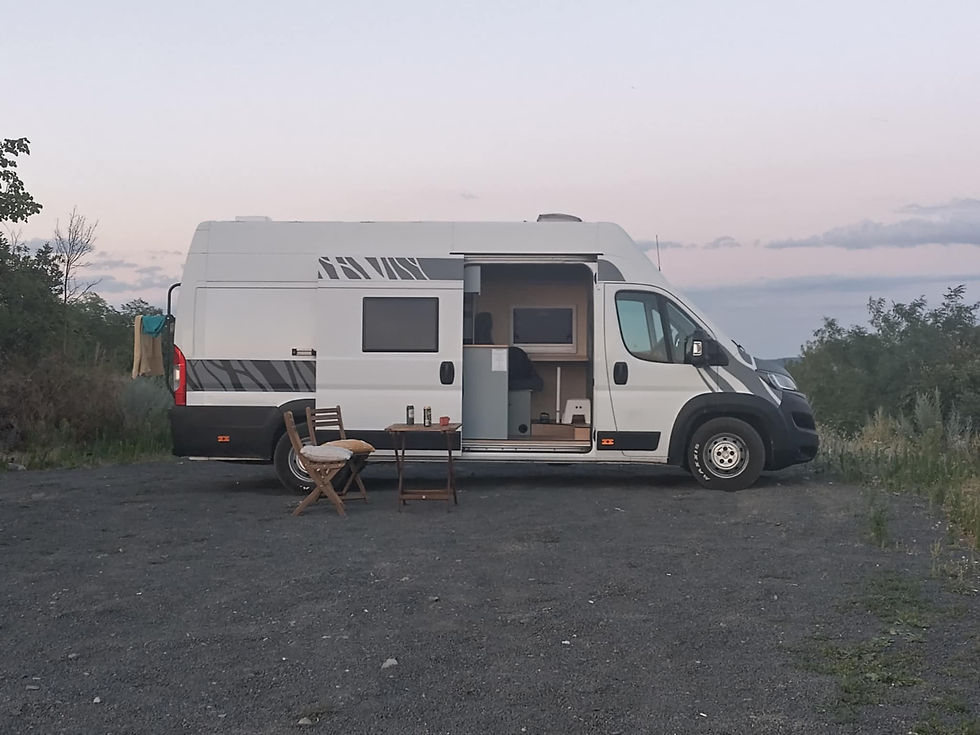
In contrast, a campervan is more like a mobile living space. While traveling, there’s no need to adapt to the weather or changing conditions: rain or wind no longer matter when you always have a sheltered interior, a bed, a kitchen, and often even a bathroom. This level of comfort becomes especially important on longer trips or during multi‑day stops, where it’s no longer just about where you sleep, but also about how comfortably you can spend time outdoors—even far from cities or villages. At the same time, campervans are less flexible: their size, parking options, and legal restrictions often limit where and how you can stop.
Flexibility and Comfort – Is a Compromise Necessary?
Flexibility is undoubtedly one of the rooftop tent’s greatest strengths. It’s ready for use within minutes, making it ideal for spontaneous trips or quick changes of location. One of its biggest advantages is that you can set off in your own, well‑known and trusted car.
This is especially beneficial in mountainous regions or on narrow Alpine roads, where driving, parking, or even turning around in a campervan can quickly become stressful.
Of course, traveling with a rooftop tent also comes with a few things worth paying attention to. One is the increased overall height of the vehicle. Fortunately, this only needs to be measured once before departure; from then on, you can consciously adapt when entering parking garages, passing under low bridges, or encountering height restrictions.
Another consideration is vehicle handling, since the weight is placed on the roof. This is most noticeable when cornering or during sudden maneuvers, but under normal road conditions it’s almost imperceptible. For those traveling primarily on asphalt, Alpine roads, or highways—rather than off‑road—the driving experience remains virtually unchanged.
For travelers who don’t know exactly where their journey will end for the night, a rooftop tent offers a genuine alternative to traditional campervans. With a quality mattress in a premium rooftop tent, comfort doesn’t have to be sacrificed either. The iKamper Skycamp 3.0, for example, offers a sleeping area of 210 × 196 cm, equivalent to a king‑size bed. While some larger integrated motorhomes also provide king‑size sleeping areas, the beds in average semi‑integrated models (such as French beds around 200 × 135–150 cm) are typically smaller.
As for additional comforts, they’re largely a matter of space, opportunity, and personal needs. Today, almost everything can be achieved on a smaller scale—or simply done differently than in a campervan. You can bring a water tank for showering, camping chairs and a table, a gas stove for preparing hearty breakfasts or dinners, a high‑capacity power bank, or even a large, fully functional cooler. If everything fits in the car alongside clothing and other essential gear, you’ll hardly have to go without anything—despite being out in nature.
For a short weekend getaway or a quick escape, however, far less is actually needed. More adventurous travelers, with a bit of assistance—such as an interior insulation kit for an iKamper rooftop tent—may even find comfort camping in places like the Bakony Hills in November. Just as we did.
That said, it’s worth asking: do we really need all these things to truly relax, or does the timeless saying apply here as well—that less is sometimes more? Of course, there are multiple perspectives. With thoughtful planning, a couple or a group of friends can comfortably manage even a week of travel with a larger car and a rooftop tent.
A family with three children, however, can’t realistically head out for a long weekend with just a few sleeping bags, two skewers, and some bacon. For them, a campsite combined with a rooftop tent can be an ideal solution, as on‑site amenities—such as drinking water, showers, electricity, restaurants, snack bars, and shops—take a significant burden off their shoulders.
In mid‑summer 2026, for example, waterfront pitches at campsites in Révfülöp and Balatonakali cost around HUF 80,000–100,000 for five people staying four nights (source: Balatontourist). On a 100 m² pitch, there’s ample space beside the car: room for children to play under a shade tarp, a table and chairs comfortably set up in the shade, and even plenty of space left for a grill.

Campervans, by contrast, place comfort front and center, offering most of the features mentioned above in one compact living space. A converted van or motorhome may include a kitchen, bathroom, and even a living area, while factory‑built premium models can feel much like traveling with a luxury Airbnb. This level of equipment—especially valuable on longer trips—can, however, significantly limit mobility. City centers and narrow streets can quickly become challenging, and spontaneous “off‑the‑road” detours may prove difficult.
When talking about comfort, it’s also worth mentioning sound insulation. In this regard, there are notable differences between campervans and rooftop tents. A campervan—whether fully integrated, semi‑integrated, or a converted van—features a closed, insulated body. Thicker wall panels, insulation, and built‑in furniture help dampen external noise. As a result, when sleeping in a busier parking area or campsite, wind noise, passing cars, or conversations from nearby campers tend to be less noticeable.
A rooftop tent, on the other hand, is structurally much closer to a traditional tent. Its fabric walls and large windows allow outside sounds to enter almost unhindered. Strong winds, a car arriving late at night, or even natural sounds such as birds or nocturnal animals feel much closer and more immediate. For some, this can be disruptive; for others, it’s exactly why rooftop tent camping is appealing—it creates a stronger sense of connection with nature. In the middle of a forest, for example, it can be a truly special experience.
During the summer of 2025, we gathered many positive experiences—and quite a few useful lessons—while traveling the Balaton Uplands in a rented campervan. Built on the largest Fiat Ducato base (L4H3), this motorhome was equipped, among other things, with a shower, induction cooktop, sink, and a mattress bed that exceeded the comfort of a standard French bed. I was slightly nervous about driving such a large vehicle, but overall the trip went smoothly. That said, roundabouts, narrow streets, and steep inclines required extra caution and careful maneuvering. Despite this, we still managed to make it all the way up to the Panoráma Campsite in Kapolcs.
Over seven days, we covered nearly 1,000 kilometers, traveling through hills and valleys, from one location to another, passing through small villages. We tried to make full use of the campervan—at least as much as we could. Although the induction cooktop initially seemed like a modern and convenient solution, in practice it proved far from ideal, especially when the goal is off‑grid, independent travel. This setup turned out to be a significant compromise during our journey.
Based on our experience, shorter daily driving distances almost inevitably required stopping at campsites to recharge the batteries, as driving alone didn’t provide sufficient charging. Accessing lakeshores and shaded spots was also often challenging, further limiting opportunities for spontaneous stops. And to be honest, with the vehicle’s 2.8‑meter height, passing under certain overpasses made us instinctively duck our heads.
When we picked up the campervan, we were told during the handover that the Ducato did not have a gray water tank and that wastewater from the shower and sink drained directly onto the ground. Accordingly, we used biodegradable cleaning and hygiene products. However, during the trip, it became apparent that the vehicle did indeed have a gray water tank—and that it had filled up. After a sharper turn, a strong and unpleasant odor suddenly filled the living area. We eventually managed to empty the tank, but this experience certainly didn’t add to the highlights of the trip.
This issue could be attributed to poor preparation or oversight on the rental company’s part, but at this price point, one reasonably expects accurate information and fully functional essential systems.
For Those Who Prefer Hard Numbers
When people first see the daily rental price, it’s easy to jump headfirst into the adventure—but proper planning requires digging a little deeper. Renting and operating a campervan comes with several cost items that are easy to overlook at first glance.
Let’s start with the fixed, unavoidable costs. In our case, the rental fee for seven days was just over HUF 300,000 net. This is actually a very competitive price: at most larger campervan rental companies, you’ll mainly find older models or converted vehicles at slightly lower rates. During peak season, daily rental prices for premium models typically fall between HUF 55,000 and 75,000 net.
Beyond the rental fee, the biggest financial commitment is usually the security deposit. While technically not an expense, it can be painfully absent from your bank account during the trip. Most rental companies require a deposit ranging from HUF 200,000 to 400,000, depending on the vehicle’s value and equipment level.In many cases, a one‑time service or preparation fee is also charged, usually around HUF 20,000–40,000. What this fee includes varies by provider, but it generally covers full interior cleaning, a gas bottle, chemical toilet supplies, and filling the water system. If you want to avoid an additional cleaning fee at the end of the rental (which can be HUF 15,000–20,000), the vehicle needs to be returned in roughly the same clean condition as received—this includes emptying the toilet tank.
Optional comfort features usually come with their own daily surcharges. These may include camping accessories, a bike rack, traveling with pets, and in many cases even festival attendance. While most campervans in Hungary fall into the D2 toll category, abroad—especially on highways and ferries—the vehicle’s height and axle configuration often result in higher tolls and fees than those charged for a passenger car with a rooftop tent.

For a premium rooftop tent, daily rental rates typically range between HUF 20,000 and 30,000. With many rental providers, this price only covers the tent itself. At Grand Tent Adventures, however, you can choose from three different equipment packages, tailored to various travel needs. There’s also the option to create a fully customized setup. Alongside the iKamper Skycamp 3.0 and Skycamp 3.0 Mini rooftop tents, we offer a wide selection of practical accessories—so you don’t have to compromise on comfort during your adventures.
While the lower rental price is certainly appealing, there are still a few additional factors to consider. If you don’t already have a roof rack and/or crossbars, these will need to be rented separately. This can easily be arranged for approximately HUF 2,000–4,000 per day at Thule partner stores, which are available at hundreds of locations nationwide.Professional installation and removal typically cost between HUF 5,000 and 15,000. Compared to the high security deposits required for campervans, rooftop tent rentals usually involve a much more manageable deposit of HUF 100,000–200,000—a significantly lighter burden on the overall travel budget.
In the table below, we’ve compiled a selection of figures to help compare campervan rentals available on the market with iKamper rooftop tent rentals offered by us, based on 2026 pricing. For campervans, we examined three distinct categories, roughly differentiated by size and equipment level.
The prices listed in the iKamper rooftop tent column represent average rates and are not tied to a specific package. Our packages are designed to suit various travel styles and individual needs, offering flexibility whether you’re planning a minimalist getaway or a more comfort‑oriented adventure.
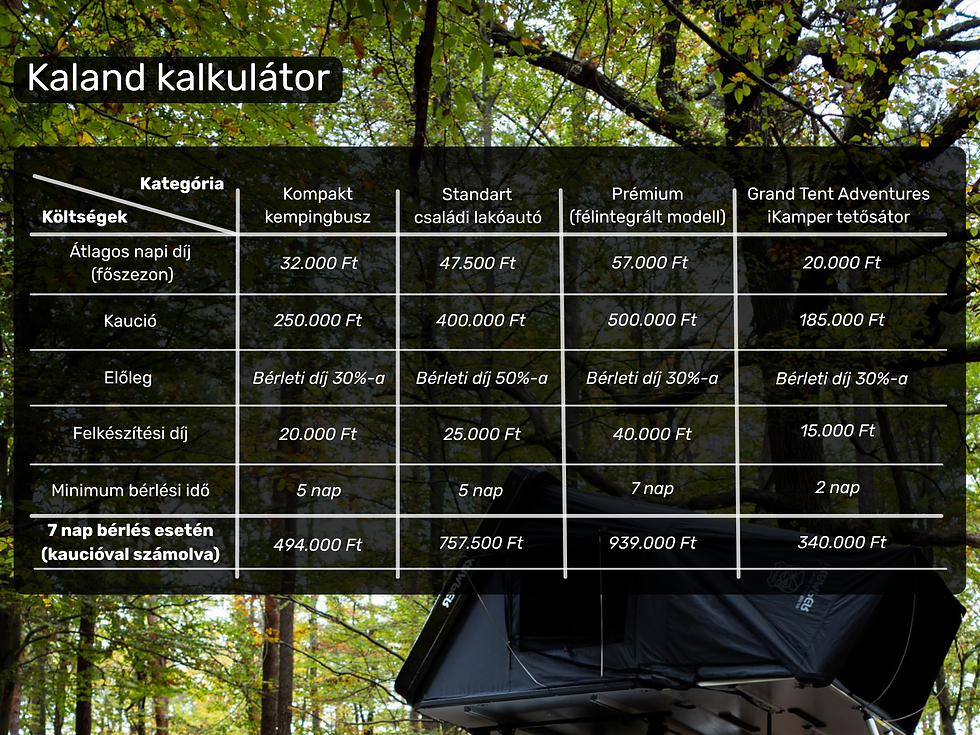
*The prices shown in the table are indicative average figures. In the case of iKamper rooftop tents, final pricing depends on the selected tent size and chosen package. For exact and up‑to‑date prices, please visit our website.
Rooftop Tents and Campervans Are Not Alternatives to Each Other
From an energy perspective, rooftop tent travel requires far fewer compromises. There’s no need for high‑capacity batteries, inverters, or external power sources, making the journey much less dependent on technical systems. This not only simplifies daily life on the road, but also makes it more predictable—especially on trips that involve shorter driving distances and frequent stops.
While camping fees can apply to both options, traveling with a rooftop tent often allows you to stay longer in places with little or no infrastructure. This means you’re less tied to paid campsites and gain greater spontaneity when it comes to both location and costs. With campervans, maintaining proper energy supply and comfort almost always relies on some form of paid service, which can become a significant budget item on longer journeys.
If major cities are among your destinations, there are a few additional factors worth considering. Many large European cities now have specific regulations for campervans. Environmental zones are in place in cities such as Paris, Berlin, and Antwerp, where access is restricted to vehicles that meet certain emissions standards. In addition, larger campervans are often completely banned from historic city centers, and overnight parking is frequently allowed only in designated camper areas. In many popular coastal cities—particularly within the EU—height‑restricted barriers have also been installed at parking entrances since 2025, preventing larger campervans from entering.
Ultimately, our experiences showed us that true freedom doesn’t necessarily lie in maximum comfort. Traveling with a rooftop tent is simpler, more flexible, and less restrictive, while a campervan represents a more secure—but also more compromise‑driven—solution. Which option is the better choice depends entirely on individual priorities: whether comfort or freedom of movement matters more during the journey.


Comments